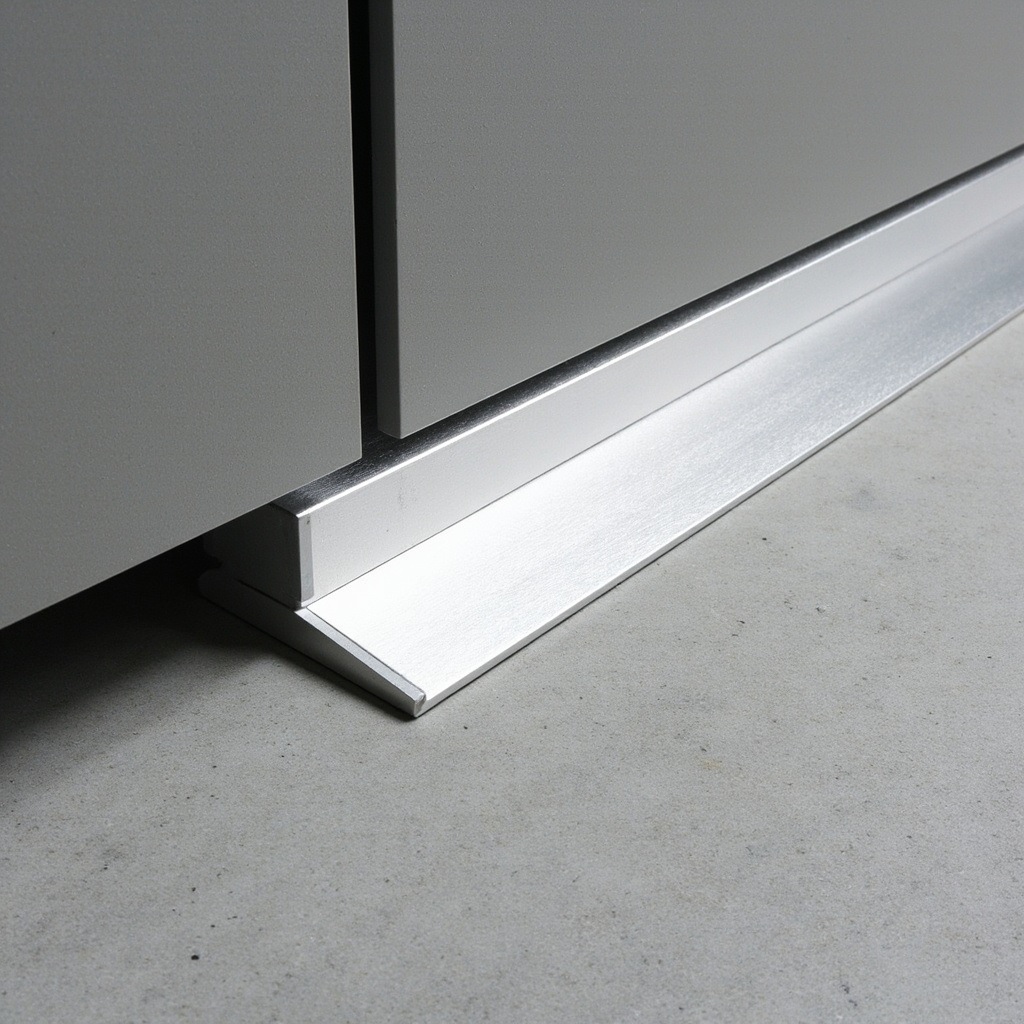
 The first time I watched a crew rip out a perfectly good baseboard from a 1970s office block, I felt a twinge of guilt. Not because the wood was beautiful—it was that sad, grey-beige MDF that crumbles if you look at it wrong—but because of the sheer waste. That pile of splintered, glued, and nailed detritus was heading straight for a landfill. It was the architectural equivalent of a single-use plastic fork. And that moment crystallized a problem that modular and adaptive reuse projects have been wrestling with for years: how do you build for tomorrow when you’re still using yesterday’s disposable details?
Enter the demountable Aluminum Alloy Baseboard. It sounds like a niche product, something you’d find in a dusty trade catalog between “insulation tape” and “joist hangers.” But in the world of modular construction and adaptive reuse, this slim metal strip is quietly becoming the unsung hero of the circular economy. It’s the difference between a building that is a static monument and one that is a living, breathing, reconfigurable organism.
Let’s get one thing straight: modular architecture is obsessed with speed and precision. You build components in a factory, ship them to a site, and snap them together like a giant, expensive LEGO set. The problem? Traditional baseboards are the enemy of speed. They require miter cuts, caulking, nail guns, and a lot of swearing when a wall panel is off by a quarter-inch. A demountable aluminum baseboard, on the other hand, clicks into place. It uses a track system that mounts directly to the substrate, and the face cover snaps on with a satisfying, mechanical lock. No glue. No nails. No waiting for paint to dry. In a modular project where every minute of site labor costs a premium, that speed translates directly into cold, hard cash.
But the real magic happens when you look at adaptive reuse. This is where buildings get a second, third, or fourth life. A 1920s textile mill becomes a tech incubator. A 1980s shopping mall becomes a medical center. These projects are brutal on interior finishes. Walls get moved. Mechanical systems get ripped out. Floor plans get flipped upside down. If you installed traditional wood or MDF baseboard in that mill, you are essentially sentencing that material to death the moment the first wall gets relocated. It will be destroyed during removal. It cannot be reused. It is a one-hit-wonder.
The demountable aluminum baseboard is a career performer. It is designed to be uninstalled as easily as it was installed. Pop off the face cover, unscrew the track, and the entire assembly is ready for its next gig. The aluminum itself is infinitely recyclable, but more importantly, it is infinitely *reusable*. You can pull it out of a building that is being gutted, wipe it down, and install it in a new modular pod across town. This isn’t just eco-friendly marketing fluff; it is a tangible asset on a balance sheet. When a developer knows that their interior finishes have a residual value and a second life, the initial investment in a higher-quality aluminum system suddenly looks like a bargain compared to the disposable cost of cheap wood.
Let’s talk about the elephant in the room: aesthetics. People hear “aluminum” and think of a cold, industrial dock. That’s a decade-old stereotype. Modern demountable aluminum baseboards come in anodized finishes, powder-coated colors, and even realistic wood-grain textures that would fool a carpenter. They are sleek, low-profile, and they solve the eternal problem of expansion and contraction. Wood baseboards shrink in winter and swell in summer, leaving ugly gaps that require caulk touch-ups. Aluminum stays put. It is dimensionally stable. In a modular unit that is trucked down a highway, shaken, and then lifted into place, that stability is non-negotiable. Wood will crack. Aluminum will shrug it off.
The cynical analyst in me also loves the maintenance angle. Think about a hospital, a hotel, or a co-working space. The baseboard is the front line of abuse. Vacuum cleaners bang into it. Mops splash against it. Carts scrape it. Wood dents. MDF absorbs moisture and swells into a fuzzy mess. Aluminum laughs. It is impervious to water. It doesn’t rot. It doesn’t harbor mold. In an adaptive reuse project where you are dealing with old concrete slabs and potential moisture wicking, that waterproof barrier is not a luxury—it is a necessity.
So, why isn’t every architect specifying this? The answer is inertia. We are trained to think of baseboard as a sacrificial, decorative afterthought. We budget for it as a consumable. The shift to demountable aluminum requires a mental pivot: treat the baseboard as a strategic component of the building’s future flexibility. It requires a slightly higher upfront cost, but the total cost of ownership plummets.
For the modular builder, it means a faster, cleaner install with zero punch-list items for cracked corners. For the adaptive reuse developer, it means a building that can be reconfigured without a demolition crew. For the planet, it means one less pile of splintered MDF in a landfill.
The next time you walk into a renovated loft or a brand-new modular apartment, look down. If you see a clean, sharp line of aluminum, you’re looking at a building that was designed to change. And that is the only kind of architecture worth building.
Leave a Reply